
Xanax withdrawal symptoms can show up when you cut back or stop taking Xanax after using it regularly. Most people notice anxiety, trouble sleeping, and shakiness, and in serious cases it can lead to seizures or hallucinations. Because Xanax leaves your body quickly, symptoms can start sooner than you’d expect, and stopping suddenly can be life-threatening. Below, we’ll cover what withdrawal feels like, how long it lasts, and how to get off Xanax safely.
Why Xanax Withdrawal Happens
Xanax (alprazolam) is a benzodiazepine. It calms the brain by boosting GABA, the chemical that slows nerve activity. When you take it every day, your brain adjusts and starts relying on it. Take it away quickly and your brain has to readjust without it, which is what brings on withdrawal.
This is physical dependence, and it can happen even when you take Xanax exactly as prescribed. People who take higher doses, or take it for longer, are at greater risk of withdrawal reactions. For many people, the risk of significant withdrawal starts after one to three months of regular use at moderate to high doses.
Common Xanax Withdrawal Symptoms
Withdrawal can bring a mix of mental and physical symptoms, including:
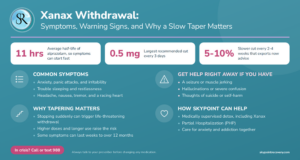
- Anxiety, panic attacks, irritability, and restlessness
- Trouble sleeping
- Headache, dizziness, and fatigue
- Nausea, vomiting, diarrhea, and loss of appetite
- Tremor, muscle pain, and stiffness
- A racing heart and higher blood pressure
- Sensitivity to light and sound
- Blurred vision, poor memory, and feeling detached from yourself or your surroundings
Many of these feel like the anxiety Xanax was treating in the first place, so it can be hard to tell withdrawal apart from the original problem.
Dangerous symptoms that need emergency care
Severe reactions can also happen, including seizures, hallucinations, delirium, psychosis, catatonia, mania, and suicidal thoughts. Call 911 or go to the nearest emergency room if you or someone you love has a seizure, becomes confused, or sees or hears things that aren’t there. If you’re having thoughts of suicide, call or text 988.
How Long Does Xanax Withdrawal Last?
There’s no single timeline, since dose, how long you’ve taken it, and your health all change it. What is well established:
- It can start quickly. Alprazolam has an average half-life of about 11 hours, so levels in your body drop fast once you stop.
- The acute phase comes first. Stopping suddenly or cutting the dose fast can trigger acute withdrawal reactions in this phase, including seizures, and these can be life-threatening.
- Some symptoms can linger. Protracted withdrawal symptoms, such as anxiety, trouble thinking, and sleep problems, may last weeks to more than 12 months.
A gradual taper won’t always prevent every symptom, but it lowers your risk of withdrawal reactions, including the dangerous ones.
What a Safe Xanax Taper Looks Like
A taper lowers your dose in planned steps instead of stopping all at once, and the guidance on how fast to go is fairly specific. The FDA prescribing label for Xanax says to lower the dose by no more than 0.5 mg every 3 days. A newer tapering guideline from the American Society of Addiction Medicine and nine other medical groups favors a much slower, more personalized pace.
| Taper detail | Recommended pace |
| Fastest label pace | Reduce by no more than 0.5 mg every 3 days. Some people need to go slower. |
| Newer starting pace | Cut the dose by 5% to 10% every 2 to 4 weeks. |
| Newer upper limit | Don’t exceed a 25% cut every 2 weeks. |
| Total time | Months to years for someone who has used a high dose for a long time. |
Whatever the pace, benzodiazepines should never be stopped abruptly in someone who is likely dependent.
In practice, a good taper:
- Follows a written plan from your prescriber, adjusted to how you feel
- May start by switching from Xanax to a longer-acting benzodiazepine such as clonazepam, which is worth discussing with your prescriber
- Pauses or slows down when symptoms get hard to manage instead of pushing through
- Treats the anxiety or sleep problem underneath, so there’s something in place when the Xanax is gone
- Includes a plan for cravings and relapse if you’ve been taking more than prescribed
Why Mixing Xanax With Other Drugs Raises the Stakes
Xanax is especially risky with opioids, since the combination can slow your breathing to a dangerous degree. You should also avoid alcohol and other sedating drugs while taking it. In Ohio, benzodiazepines were involved in 375 unintentional overdose deaths in 2023, 8% of the state’s total and a 4% increase over 2022, based on the Ohio Department of Health’s 2023 overdose report. If you use Xanax alongside other substances, it’s much safer to go through withdrawal and recovery with medical oversight.
When to Consider Medical Detox
A supervised setting makes sense if any of these apply to you:
- You take a high dose, or you’ve taken Xanax daily for months
- You’ve tried to cut back before and couldn’t
- You take more than prescribed, or buy pills outside a pharmacy
- You also use alcohol, opioids, or other drugs
- You’ve had a seizure, or severe anxiety or depression, in the past
Buying pills outside a pharmacy carries its own danger. Many fake pills are made to look like Xanax but contain fentanyl, and some hold a potentially lethal dose.
How Skypoint Recovery Helps
At Skypoint Recovery in Akron, our medically supervised Xanax detox gives you a team to get you through withdrawal safely. Our medical professionals monitor your symptoms and adjust medications as needed, so you aren’t facing the hardest days alone. After detox, our partial hospitalization program offers up to six hours of therapy on most days, and it helps people with co-occurring conditions like anxiety alongside substance use. If Xanax started as a sleep aid for you, our look at alprazolam for sleep explains the risks of that path, including dependence and withdrawal.
You don’t have to figure out the taper on your own. Reach out to our team to talk through your options confidentially.
Frequently Asked Questions
1. How long does Xanax withdrawal last?
The acute phase comes first, after you cut back or stop. Some people then have lingering anxiety, sleep problems, or trouble concentrating that can last weeks to more than 12 months. A gradual, supervised taper lowers the risk of withdrawal reactions.
2. Can you die from Xanax withdrawal?
Yes, it can be fatal in some cases. Stopping Xanax abruptly or cutting the dose quickly can cause life-threatening withdrawal reactions, including seizures. That’s why you should never stop suddenly after regular use.
3. When does Xanax withdrawal start?
It can start soon after your last dose. Xanax has an average half-life of about 11 hours, so the amount in your body drops quickly once you stop. Some prescribers switch people to a longer-acting benzodiazepine before tapering for that reason.
4. What helps with Xanax withdrawal?
The most effective step is a gradual taper planned with your prescriber, often with medical supervision if you’ve used it heavily. Support for the anxiety and sleep issues underneath, through therapy and structured treatment, helps you stay off it once the taper is done.
Related Blogs



Freedom Is Just a Call Away
Skypoint Recovery offers personalized treatment programs led by experienced professionals who understand your journey. We’ll help you build the foundation for lasting recovery through evidence-based care tailored to your needs. Your path to healing awaits – reach out for a confidential consultation.
 Call Us Now
 Trusted Partners